
Why a dual-use auditorium breaks a single-purpose lighting spec
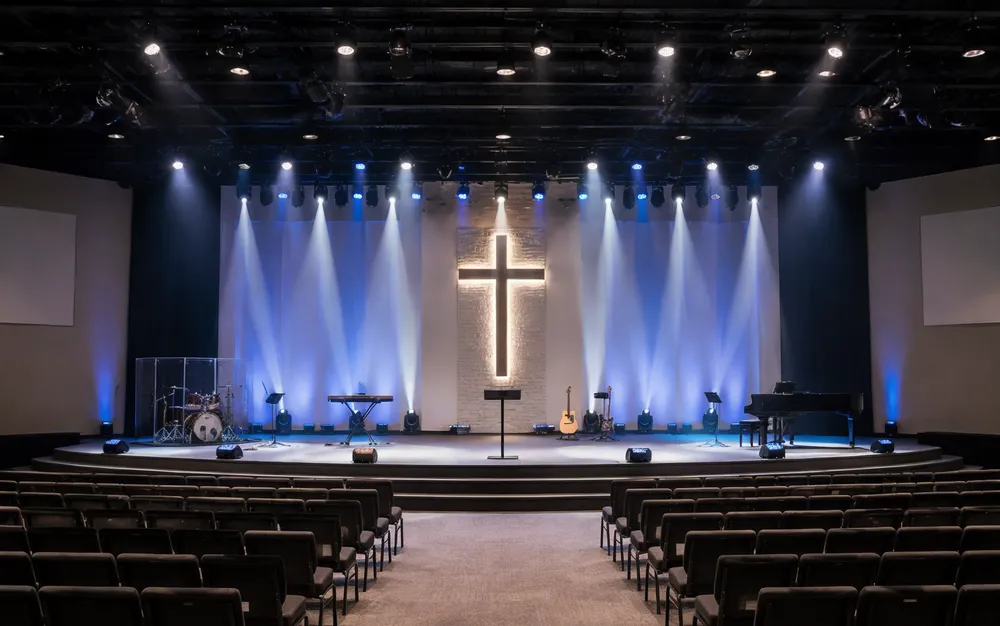
The call we get most often starts the same way. The room was lit for Sunday worship — three or four people at center platform, warm front light, colored wash on the back wall, everyone happy. Then the venue hosts a high school graduation, forty students line up across the full platform width, and the outer thirds of the stage read 40% darker than center because every fixture was aimed at a worship band footprint.
Nobody specified that badly on purpose. The fixture package was sized for one mode, and the room has four.
Auditorium stage lighting in a multi-use venue is the fixture package plus the control layer that lights a platform serving more than one kind of event. That second half of the sentence is where the money gets won or lost. You are satisfying three demands at once: what the congregation sees from row 20, what the camera records for livestream, and what a full-platform event needs for even coverage edge to edge. Those three pull in different directions on intensity, color temperature, and aiming.
The position I take on every Church Stage Lighting project is simple: size the fixture package for the most demanding mode, then let DMX zoning handle the switch between modes. Buying a separate rig for each use case doubles your cost. Buying for the easiest mode guarantees you rebuy within three years.
Across the sanctuary and multi-purpose auditorium lighting projects I've supported over the past decade, the regret I hear is almost never "we bought too little capability." It's "we bought capability nobody on the volunteer team can actually reach."
Lux, beam angle, and color temperature targets for each operating mode
Start with the numbers, because this is where most auditorium lighting design conversations skip ahead too fast. Below are typical working reference ranges used in worship and multi-use venues. They are planning targets, not certified values — your room geometry, surface reflectance, and camera package will shift them.
| Operating mode | Platform lux (horizontal) | Face-level lux (vertical) | Beam angle range | CCT range | CRI floor | Front-to-back uniformity |
|---|---|---|---|---|---|---|
| Worship service, in-room only | 400-700 | 300-500 | 25°-40° key, 40°-60° wash | 3000K-3500K key | 80+ | 2:1 acceptable |
| Worship service, livestream priority | 700-1,000 | 600-800 | 19°-26° key, 40°-60° wash | 3200K-4000K key, locked | 90+ | 1.5:1 target |
| Conference, presentation, graduation | 500-800 flat | 400-600 | 36°-50° across full width | 4000K-5000K | 80+ | 1.5:1 across full platform |
| Community performance, drama, concert | 400-900, scene-dependent | 300-700 | mixed 15°-60° | 3000K-5600K variable | 80+ | 2:1 acceptable |
The hardest number on that table is face-level lux, and it's the one most quotes ignore completely. Cameras respond to vertical illuminance on a face, not to horizontal illuminance on the floor. A platform that measures a comfortable 600 lux on the deck can still deliver a dim, noisy camera image if the front key fixtures are mounted too steep and the light is falling on foreheads instead of faces.
That's why the livestream row drives your fixture count even when livestream is the less frequent use. It sets the front-of-house requirement. Everything else in the room can be reached by dimming down from there.
Color temperature is the other place where auditorium lighting quietly fails. Lock your key-light CCT and vary the wash, never the reverse. When a 3200K front key sits alongside a 5000K overhead downlight, the camera's white balance picks one and the other goes green or magenta on skin tones. Mixed CCT on faces is the single most common cause of the "our livestream looks washed out" complaint, and no amount of color correction in the stream software fixes it cleanly.
On CRI, be honest with your budget. If the venue has no cameras and no plan to add them, paying for 95+ CRI across forty fixtures buys you very little that anyone in row 20 will notice. If you are streaming, front-of-house CRI is where that money belongs, and the wash fixtures can sit lower. (I'd rather see eight high-CRI front fixtures and twenty standard wash units than thirty uniformly mid-grade fixtures — the camera only reads faces.)
Uniformity ratio decides whether a wide camera shot is usable. At 2:1 the far platform edge looks intentionally shadowed. Past 3:1 it looks broken, and your video team starts cropping shots to hide it.

Fixture roles by mounting position
Write your fixture schedule by position, not by product category. That's how the quote gets built, how the electrician plans circuits, and how you discover you forgot a position before the truss goes up instead of after.
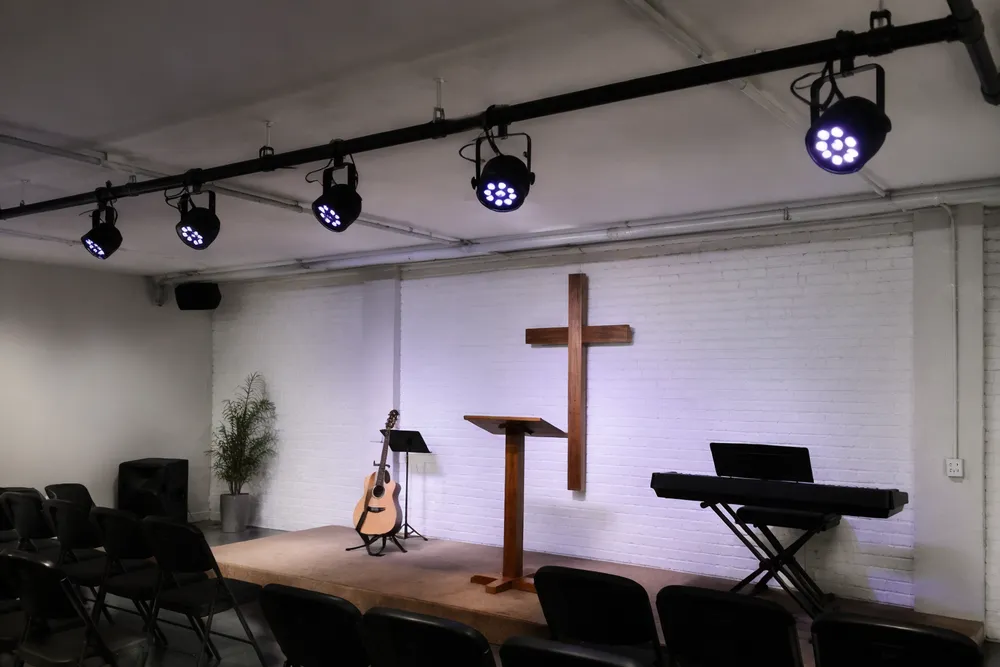
Front of house. This is key light duty and it carries the whole camera burden. Long throw from a rear or balcony-front position means narrower beam angles — typically 19° to 26° at throws over 12 meters — and this is the position that earns the highest CRI in your package. If you cut corners anywhere, don't cut here.
Overhead and top. Wash and downlight, wide beam angles in the 40° to 60° range, mounted to cover platform depth. This position fixes the uniformity gap the table above flagged. Front light alone cannot deliver 1.5:1 across a deep platform; overhead wash fills it. Auditorium LED stage lights at this position are usually your highest unit count, which makes them the biggest single lever on package cost.
Rear and back. Separation light. It's what keeps a camera image from reading as a flat cutout against the back wall, and it's also where most of your color lives during worship. Modest count, high visual return.
Side and boom positions. Optional, and I'll say that plainly. In a budget-constrained church auditorium lighting project, phase one money is better spent on front-of-house quality than on side light. Add booms later when the room's core coverage is solid.
Moving heads. Useful in a dual-use room, but keep the count small and the expectations narrow. A moving head covering three platform positions from one mount point earns its cost. Twelve moving heads doing choreography that a volunteer has to re-aim every Thursday becomes a maintenance liability. Fixed positions, recalled by preset, is the configuration that survives volunteer turnover.
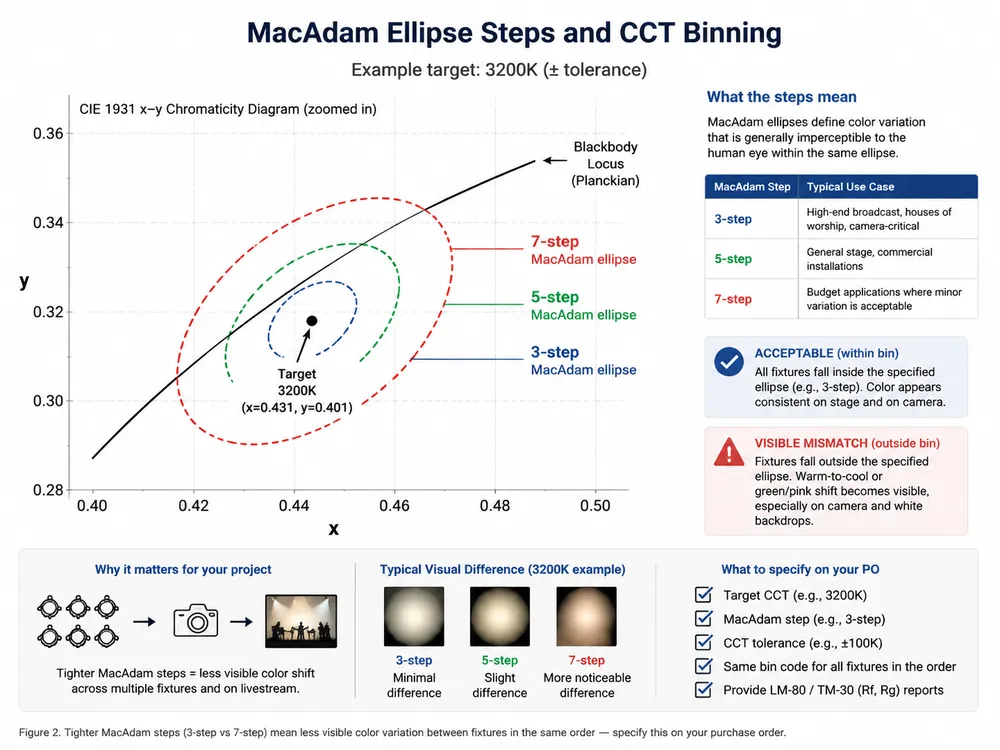
One production note that matters more than any datasheet line: beam angle and color consistency across a batch is a manufacturing control problem, not a specification problem. Our SMT lines mount LED chips at ±0.05mm placement accuracy, and incoming LED bins get rejected above 3% deviation from target CCT, so forty PARs on one truss produce one continuous color field instead of a visible patchwork. (The most frequent field complaint we see on auditorium packages is color variation across a row of wash fixtures. Nine times out of ten it's upstream bin inconsistency, not aiming.)
Fixture count, wattage, and budget planning by seating tier
Here's the framework for figuring out how to choose auditorium lighting fixtures for churches and multi-use venues at realistic scale. Treat these as starting counts to adjust, not a formula.
| Seating tier | Typical platform width | FOH throw | Front key fixtures | Overhead wash | Rear / effect | Total connected load | DMX zones |
|---|---|---|---|---|---|---|---|
| 150-250 seats | 6-9 m | 8-12 m | 4-6 | 8-12 | 4-6 | 2.5-4.5 kW | 4-5 |
| 400-600 seats | 10-14 m | 12-18 m | 6-10 | 12-20 | 6-10 | 5-9 kW | 6-8 |
| 1,000+ seats | 15-22 m | 18-28 m | 12-20 | 24-40 | 12-20 | 10-18 kW | 8-12 |
The logic underneath the table is what lets you adapt it to an odd-shaped room. Throw distance drives beam angle. Platform area drives wash count. Your most demanding operating mode drives key count. Change the room, re-run those three relationships.
For a quick sanity check on someone else's quote, LED auditorium lighting wattage per square meter of platform coverage typically lands around 25-45 W/m² for a dual-use package. Well below that range and the room will struggle in conference mode. Far above it and someone has specified touring-grade output for a venue with an 18-meter throw.
Total connected load matters more than buyers expect. A fixture package that pushes the platform circuits past capacity turns into an electrical panel upgrade, and a panel upgrade can cost more than the lighting difference between a cheap package and a good one. Pull the connected load number into your budget conversation early, before you compare unit prices. When you move from counts to mounting, the church stage lighting setup sequence covers the install side.
Wash fixtures are the highest-count line item in every tier, which is exactly where factory-direct sourcing changes the arithmetic. Twenty-four wash units bought through a distributor chain carry a margin layer on every one of them. Bought from the factory, that layer comes out of your landed cost, so your bid lands lower or your project margin holds.
Our 30-unit MOQ exists for the way these projects actually get funded. Order one zone — your overhead wash, or your front-of-house bar — install it, check it on camera and from the back row, then commit to the rest. You verify the look against your actual room before the full capital outlay, and the venue gets a visible improvement at phase one.
DMX zoning that a volunteer can switch in thirty seconds
Zoning is a purchasing decision, not a programming decision. How many independently controllable groups you buy determines whether switching from worship mode to conference mode is one button press or a twenty-minute rebuild by whoever happens to be in the booth.
For a dual-use room, the zone breakdown that works is front key, platform wash, rear and cyc, house and podium, with the front key split left/center/right once your platform passes about 12 meters. Collapsing front key and platform wash into a single zone is the mistake that ruins livestream mode — you lose the ability to pull color down while holding face light up, and that's the exact move every camera shot depends on.
Keep scene presets to a number the team can remember without a cheat sheet. Four to six: worship, teaching, full-platform event, house up, blackout, plus one spare. More presets than a volunteer can recall is functionally the same as no presets at all.
Most of the DMX complexity that overwhelms volunteer-run tech teams was locked in at purchase, not at training. Too few zones, inconsistent addressing across fixture batches, and no factory presets mean every operator rebuilds the room from scratch. That's a spec-side fix, decided before the order ships.
Our OEM/ODM work for auditorium packages often includes factory-loaded CCT settings and scene presets, programmed to the commissioning integrator's spec before shipment, so the configuration still exists in year three after three rounds of volunteer turnover. For console selection and deeper programming strategy, church lighting DMX control goes further than this article does.
Where auditorium lighting budgets get wasted
The over-spec side first, because it's where the largest dollar errors live. Moving head counts copied from a touring rider into a 500-seat room. Output ratings that assume a 30-meter throw in a venue with 14 meters. High CRI across a full package in a venue with no camera and no plan for one. Each of those is real money spent on capability the room cannot use.
The under-spec side is quieter and more expensive to fix. Most RFQs for church auditorium lighting never state a dimming curve requirement, never name a uniformity target, and never specify CCT tolerance across the production batch. Those three omissions produce fixtures that technically meet the quote and visibly fail in the room.
What to actually put in your RFQ:
- Photometric data at your stated throw distance, not generic beam charts
- CCT tolerance across the production batch, expressed as a maximum deviation
- Dimming curve behavior below 10% output, in writing
- IP rating where fixtures sit near HVAC outlets or exterior openings
- Compliance documentation matched to your import market — CE, FCC, RoHS as applicable
Low-output dimming deserves its own line. Plenty of auditorium LED stage lights dim smoothly from 100% down to 20%, then step, shimmer, or flicker below that. It never shows in a showroom demo at full output, and it always shows on camera during the quiet moment of a service when the operator has the wash at 8%. Ask for the behavior spec, or ask for a sample and test it at low output yourself.
Then there's access cost, which is specific to this application. A fixture mounted at 9 meters over fixed seating is not a fixture you swap on a Tuesday afternoon — it's a lift rental, a scheduling conflict, and a service call. Every unit we ship runs a 48-hour aging test at full electrical load followed by 100% functional testing on DMX response, dimming linearity, and color mixing, so the driver and thermal failures that would otherwise surface in month two surface in our test racks instead of at your ceiling mount point.

My standing advice on a package you haven't bought before: sample first, confirm the photometrics against your own room, and don't pay for a spec line you can't point to a use case for.
Matching the spec to your venue profile
Small auditorium, no livestream yet. Put your budget into front-of-house coverage and overhead wash count. Skip side booms, skip moving heads, keep the zone count at four or five. The one place to leave headroom is front-of-house mounting position and circuit capacity, so adding cameras in two years means adding fixtures rather than rebuilding the truss.
Mid-size with active livestream. Front-of-house CRI and locked key CCT are non-negotiable, and your face-level lux target drives the whole package. Effects, movement, and color variety can all wait for phase two. Get faces right first.
1,000+ seats with a working event calendar. Zone count and control consistency outrank fixture count here. The room gets re-lit weekly by different people for different events, so repeatable presets and consistent DMX addressing across batches save more operating cost than extra fixtures add capability.
Spec'ing for a competitive bid. Lock face-level lux at a stated measurement height, CCT and tolerance, beam angle per position, and uniformity ratio in the fixture schedule. Without those four, competing quotes aren't comparable and the lowest number wins by omitting things.
Auditorium stage lighting for worship and events comes down to four inputs. Room dimensions, seating count, front-of-house throw distance, and whether cameras are in play. With those in hand, any competent supplier can return a real fixture list with counts and connected load, and you can request quote comparisons that actually line up against each other.
Questions buyers ask while spec'ing an auditorium package
How many lux do I need on an auditorium stage for livestream video? Plan for 700-1,000 lux horizontal on the platform and 600-800 lux vertical at face height, measured about 1.5 meters off the deck. The vertical number is the one your camera cares about. A room that hits the horizontal target and misses the vertical one still produces a dim, grainy image, because floor illuminance tells you nothing about what's landing on a face.
What beam angle should I use for a 15-meter throw from the back of an auditorium? At 15 meters, a 26° fixture covers roughly 6.9 meters of platform width at its beam edge, which is usually two or three overlapping fixtures for a mid-size platform. The reasoning transfers to any distance: multiply throw distance by about 0.46 for a 26° beam, 0.33 for 19°, and 0.72 for 40° to get approximate coverage width. Then overlap by 30-40% so you don't get scalloped hot spots between fixtures.
Can one fixture package serve both worship and conference lighting? Yes, under two conditions. Your key light has to be independently controllable from your wash, and your key CCT has to be a tunable or locked white rather than a fixed warm. Those two things let one package deliver 3200K worship key and 4500K conference flat coverage from the same fixtures. Without them you're buying two rigs.
Why does our auditorium lighting look washed out on camera? Check in this order. First, mixed CCT on faces — a warm front key fighting a cool overhead downlight, which is the usual culprit. Second, vertical illuminance too low while horizontal reads fine. Third, front light too steep, putting light on foreheads instead of faces. Fourth, CRI low enough that skin tones are reproducing flat. Fixing the first two resolves most cases.
Do we need moving heads in a church auditorium? Usually no, not in phase one. They earn their cost in two situations: when one fixture needs to serve several platform positions across different event types, and when the room hosts real performance events where movement is part of the production. If the answer is "it would look impressive," put the money into front-of-house CRI instead and you'll see more improvement on every camera shot.
What's the MOQ and lead time on an auditorium fixture package? 30 units minimum, including mixed models, with production lead time typically 20-35 days depending on configuration and quantity. Samples run 3-7 days on standard models. For phased projects, ordering one zone at a time keeps you above MOQ while spreading the capital across budget cycles.